- The Leader Mindset
- Posts
- The Leader Mindset #52
The Leader Mindset #52
One Year of the Leader Mindset - Leveraging the Athlete Mindset for Leadership Growth

Andy Noon, PhD
March 15, 2026

Hi everyone,
This week marks the one-year anniversary of The Leader Mindset and the publication of my 52nd article.
Thank you for being a subscriber and taking part in the journey.
Over the past year, I’ve reflected on many difficulties and possibilities leaders face, from classic topics like delegation, decision-making, and time management to newer issues like AI and technological change.
One thing I’ve learned from writing a newsletter is that you don’t always know who’s reading or how your ideas are received. But sometimes, someone reaches out to say an article helped them see leadership differently or solve a team problem.
Those messages mean a lot to me.
If you’re new to The Leader Mindset, here’s a link to the most-read article from the past year. Why Delegating Feels So Hard and How to Finally Get It Right
And if you’ve found value in the newsletter, please consider sharing it with someone in your network who might benefit.
Thanks again for reading.
Andy

Leveraging the Athlete Mindset for Leadership Growth
Recently, I saw a graphic on social media comparing how professional athletes develop to how people grow in the corporate world. The image is simple, but its message is strong.
For athletes, development is a steady cycle. They practice, compete, see what needs work, and then practice again. A basketball player might miss free throws in a game, spend weeks practicing them, and then see if the practice pays off in the next game. Golfers work on their short game, and musicians repeat tough parts until they get them right. It’s a deliberate, ongoing process: play, practice, improve, and repeat.
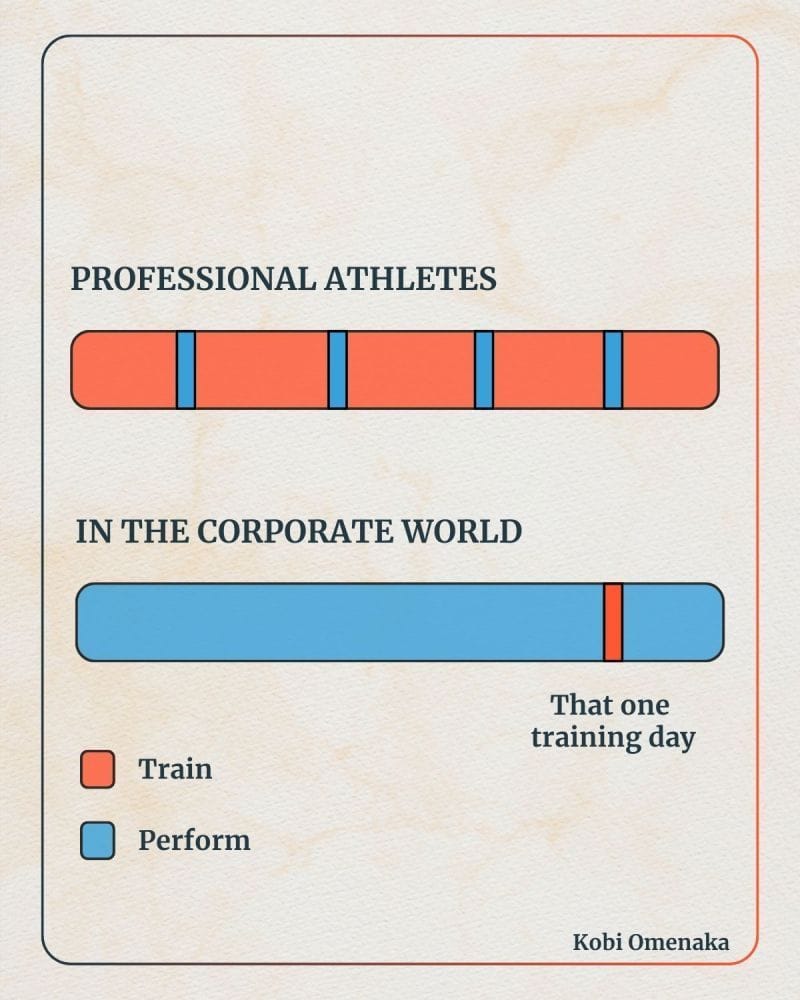
The graphic shows a different picture for the corporate world. Instead of a steady cycle, leadership development is shown as mostly “performing,” with just a small “training day” in the middle. In other words, development happens rarely—maybe at a conference, workshop, or leadership program—before leaders go back to their usual work.
At first, the comparison seems accurate. But the more I thought about it, the more I realized it’s not completely fair.
Leadership development is not as limited as that image makes it seem.
Leadership Development Is Happening All the Time
In reality, leaders are always developing, often in ways that don’t look like formal training. Every tough conversation with an employee is a chance to practice coaching. Feedback from colleagues or supervisors shows how your leadership style comes across. Taking on new challenges forces leaders to build new skills quickly.
Leaders also learn through everyday activities. They read articles, skim leadership books, listen to podcasts on their commute, or watch short videos about managing conflict or running meetings. They talk with peers over lunch about workplace challenges and hold meetings to better understand what’s happening on the front lines.
All these experiences help leaders grow. In fact, most leadership development happens on the job. Unlike classroom learning, leadership is practiced every day in real situations with real consequences.
So, the problem isn’t a lack of opportunities. Today’s workplace actually gives leaders more ways to learn than ever before.
The real issue is something else.
Athlete Development and the Power of Intentionality
What really sets athletic development apart from leadership development isn’t how often learning happens. It’s the intention behind it.
Top athletes are very disciplined about finding the skills that will help them improve. They don’t practice everything. Instead, they focus on what matters most for winning the next game or event.
A basketball player who misses free throws might shoot a hundred free throws after every practice. A golfer with a crappy short game might spend hours practicing chip shots. A guitarist wanting to jam “Master of Puppets” will repeatedly practice the hardest parts until it becomes automatic.
Their practice is focused, measurable, and directly aligned to performance improvement.
Leadership development, on the other hand, can feel scattered. Leaders might read a book one week, watch a video the next, go to a seminar, and then listen to a podcast about various topics. These activities can be helpful, but they’re rarely tied to a clear goal.
Instead of building one skill deeply, development gets spread across many ideas that might not lead to real change.
How Leaders Can Develop More Like Athletes
If leaders want to grow more effectively, they can learn a lot from how athletes improve.
1. Diagnose the most important opportunity for improvement.
Athletes spend a lot of time looking at their performance. Leaders should do this too. Tools like 360-degree feedback, coaching, and self-reflection can show where you can get better.
Ask yourself:
What behaviors would help my team?
Where am I causing friction?
What skill, if improved, would lead to better results?
2. Get intentional about what to improve.
Once you spot an area to improve, make it a priority. Top athletes don’t try to fix everything at once. Leaders should focus on one or two skills that will really boost their impact.
3. Use the Learn–Practice–Play model.
First, learn what good performance looks like. You might read about the skill, watch other leaders, or get advice from a mentor or coach. Next, practice the skill in low-risk situations. Finally, use it in real leadership moments—the “game”—and see what happens.
4. Remove development that isn’t connected to your goals.
Many leaders take in a lot of leadership content but never put it into practice. Watching lots of videos or reading many books can feel productive, but if it doesn’t lead to real change, it’s mostly wasted effort.
5. Work in short development sprints.
Athletes often train hard on specific skills for set periods. Leaders can do this too by focusing on one skill for 30 or 60 days, getting feedback, reviewing progress, and then choosing what to work on next.
6. Measure progress.
Athletes track whether practice actually improves performance. Leaders should do the same. Set specific goals and measure progress through feedback, team outcomes, or changes in your own behavior. Review improvement after 30 or 60 days, then decide whether to keep refining the skill or move to the next priority.
The Real Opportunity for Leaders
Leadership development isn’t as rare as that social media graphic suggests. Leaders are always learning, often through their daily work.
The real opportunity is to bring more focus and intention to that learning.
Athletes get better by focusing on the skills that matter most for their performance. Leaders who do the same—spotting weaknesses, practicing on purpose, and testing themselves in real situations—will see real growth.
In the end, development isn’t about taking in more information.
It’s about practicing the right things until you actually get better.
What do you think? Do you think this approach could work?
IF YOU ARE SEEKING A NEW LEADERSHIP PERSPECTIVE THIS YEAR, HERE IS HOW I CAN HELP →
Executive Coaching: Structured coaching programs to accelerate the growth of executive leaders, high potentials and transitioning leaders.
Succession Planning: We help you build a practical succession strategy that identifies and prepares your next generation of leaders.
Leadership Assessment: Whether for selection or succession planning, we leverage the right assessments to make better leadership decisions.
High-Potential Development: We create custom programs to develop your future leaders.
If any of these are priorities for your organization, I’d enjoy the conversation.
Connect with me:
LinkedIn: (12) Andy Noon, PhD | LinkedIn | Email: [email protected] Website: Decatur Street Consulting – Leadership development consultant
Andy Noon, PhD

Sent the article? Subscribe for free.
Reply